

Dividers
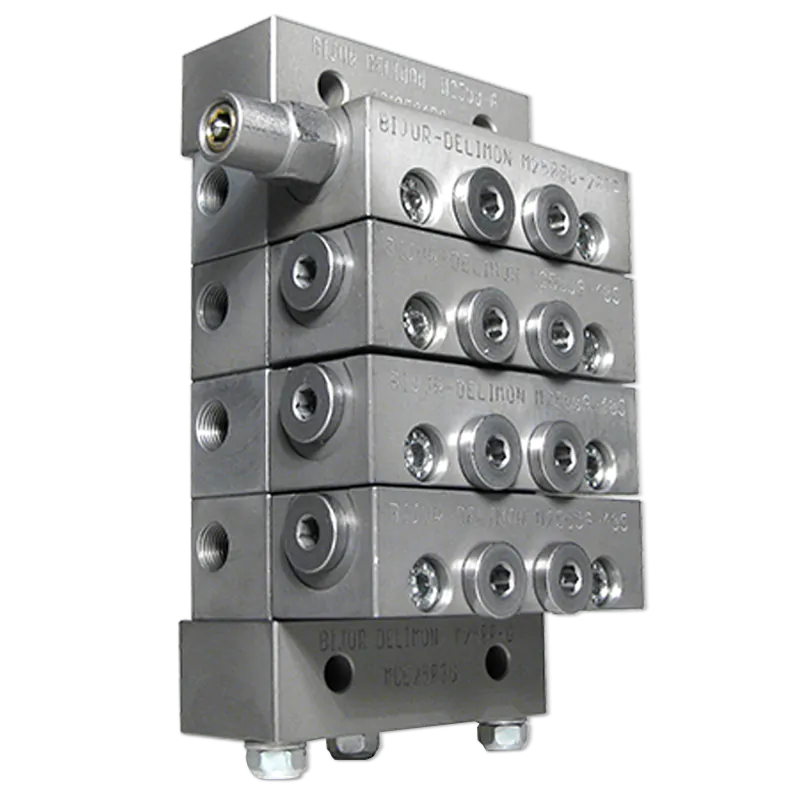
Divider Valves
Manifolds equipped with Progressive Divider Valve systems distribute and proportion incoming oil or grease to various bearing points. Each valve block within the system operates in a sequential "Progressive" manner.
The manifold valve blocks will consistently operate in a progressive fashion as long as pressurized lubricant is supplied to the inlet section of the divider.
Lubrication Dividers for Automatic Lubrication Systems
Lubrication dividers are distribution components used in automatic lubrication systems to split incoming lubricant flow into multiple, controlled outlets. Their purpose is to ensure that oil or grease is delivered evenly and consistently to several lubrication points from a single supply line.
What Are Lubrication Dividers?
Lubrication dividers are precision-machined blocks or assemblies that receive lubricant from a pump or upstream control device and divide that flow into measured or balanced outputs. Depending on system design, dividers may split flow equally or proportionally to downstream lubrication points.
Primary Use Cases
- Distributing lubricant from one supply line to multiple lubrication points
- Balancing lubricant flow across bearings, slides, chains, or guides
- Supporting centralized lubrication systems with multiple outlets
- Reducing the need for multiple pumps or supply lines
Who Lubrication Dividers Are For
- Maintenance and reliability teams managing centralized lubrication systems
- OEM machine builders designing automated lubrication layouts
- Manufacturing facilities with multiple lubrication points per machine
- Operations looking to reduce manual lubrication and improve consistency
When to Use Lubrication Dividers
- When multiple lubrication points can share a common supply line
- When consistent and balanced lubricant delivery is required
- In systems where space or layout limits individual metering devices
- When simplifying system design reduces maintenance complexity
When Dividers May Not Be the Right Choice
- When each lubrication point requires a different, precisely metered volume
- In systems requiring sequential or monitored delivery confirmation
- Where pressure or flow variations could affect downstream components
How Dividers Fit Into a Lubrication System
Lubrication dividers are typically installed downstream of a lubrication pump or control unit. Once lubricant enters the divider, it is split into multiple outlets and routed through tubing to individual lubrication points. Dividers are often used alongside meter units, injectors, and valves to create a complete and balanced lubrication network.
Common Mistakes and Misapplications
- Using dividers where metered or sequential delivery is required
- Ignoring system pressure requirements and outlet resistance
- Improper outlet sizing leading to uneven lubrication
- Failing to account for downstream tubing length differences
Key Benefits
- Even lubricant distribution to multiple points
- Simplified system layout with fewer components
- Reduced installation complexity and cost
- Improved lubrication consistency
- Lower maintenance effort compared to manual lubrication
Frequently Asked Questions
Are lubrication dividers the same as meter units?
No. Dividers split lubricant flow between outlets, while meter units are designed to deliver precise, predefined lubricant volumes to individual points.
Can dividers be used with oil and grease systems?
Yes, but dividers must be selected based on lubricant type, viscosity, and system pressure requirements.
Do dividers require regular maintenance?
Dividers are generally low-maintenance but should be inspected periodically for blockages, contamination, or uneven flow.
Related Categories
- Meter & Control Units
- Lubrication Pumps
- Distribution Elements
- Valves & Injectors
-
__38461.1744832702.png?c=2 "VALVE ASSY 5 SECT NPT (CHART)")
VALVE ASSY 5 SECT NPT (CHART)
Bijur Delimon
MSRP: $597.71$543.91Bijur Delimon M2500G Series Divider Valve Manifold — M2500B5G 5-Section Assembly · 1/8"-27 NPSF (US Standard) · Up to 10 Lubrication Points The Bijur Delimon M2500G Series Divider Valve Manifold (M2500B5G) is...M2500B5GMSRP: $597.71$543.91 -
__81164.1744832702.png?c=2 "VALVE ASSY 6 SECT NPT (CHART)")
VALVE ASSY 6 SECT NPT (CHART)
Bijur Delimon
MSRP: $697.71$634.91Bijur Delimon M2500G Series Divider Valve Manifold — M2500B6G 6-Section Assembly · 1/8"-27 NPSF (US Standard) · Up to 12 Lubrication Points The Bijur Delimon M2500G Series Divider Valve Manifold (M2500B6G) is...M2500B6GMSRP: $697.71$634.91 -
__02780.1744832702.png?c=2 "VALVE ASSY 7 SECT NPT (CHART)")
VALVE ASSY 7 SECT NPT (CHART)
Bijur Delimon
MSRP: $801.04$728.95Bijur Delimon M2500G Series Divider Valve Manifold — M2500B7G 7-Section Assembly · 1/8"-27 NPSF (US Standard) · Up to 14 Lubrication Points The Bijur Delimon M2500G Series Divider Valve Manifold (M2500B7G) is...M2500B7GMSRP: $801.04$728.95 -
__77700.1744832703.png?c=2 "VALVE ASSY 8 SECT NPT (CHART)")
VALVE ASSY 8 SECT NPT (CHART)
Bijur Delimon
MSRP: $902.14$820.95Bijur Delimon M2500G Series Divider Valve Manifold — M2500B8G 8-Section Assembly · 1/8"-27 NPSF (US Standard) · Up to 16 Lubrication Points The Bijur Delimon M2500G Series Divider Valve Manifold (M2500B8G) is...M2500B8GMSRP: $902.14$820.95 -
__60736.1744832703.png?c=2 "VALVE ASSY 9 SECT NPT (CHART)")
VALVE ASSY 9 SECT NPT (CHART)
Bijur Delimon
MSRP: $997.68$907.89Bijur Delimon M2500G Series Divider Valve Manifold — M2500B9G 9-Section Assembly · 1/8"-27 NPSF (US Standard) · Up to 18 Lubrication Points The Bijur Delimon M2500G Series Divider Valve Manifold (M2500B9G) is...M2500B9GMSRP: $997.68$907.89
