
Monitoring
Monitoring Devices for Automatic Lubrication Systems
Monitoring devices are critical components in automatic lubrication systems that provide real-time feedback on system performance. They help confirm lubricant delivery, detect faults, and ensure the system is operating as intended — improving uptime and preventing equipment damage due to missed lubrication.
What Are Monitoring Devices?
Monitoring devices include sensors, switches, and feedback modules that verify conditions such as pressure, flow, reservoir level, and delivery confirmation. They communicate system performance status to controllers, PLCs, or alarms, enabling maintenance teams to act before failures occur.
Primary Use Cases
- Confirming pressure build-up in a lubrication circuit
- Detecting low lubricant levels in reservoirs
- Reporting delivery confirmation to controllers or PLCs
- Providing fault indication and maintenance alerts
- Supporting predictive maintenance strategies
Who Uses Monitoring Devices
- Maintenance and reliability engineers
- Industrial automation professionals
- OEM machine designers integrating lubrication systems
- Manufacturing and production teams seeking uptime assurance
When to Use Monitoring Devices
- When lubrication failure could cause expensive downtime
- In systems with many lubrication points and complex distribution
- Where automated fault detection and alerts are required
- When integrating lubrication status into machine controls
- In critical equipment with tight wear tolerances
When Monitoring Devices May Not Be Necessary
- In very simple lubrication systems with low risk and few points
- Where failure has minimal operational impact
- In manual lubrication programs without automation
- Where cost or system complexity outweighs reliability benefit
How Monitoring Devices Fit Into a Lubrication System
Monitoring devices are positioned at strategic points in a lubrication system — such as reservoir wells, pump outlets, or distribution feeds — to measure pressure, level, or delivery events. They provide signals to controllers, automation systems, or displays so that lubrication status can be confirmed and maintenance action can be triggered when needed.
Common Types of Monitoring Devices
- Pressure switches – Confirm line pressure and detect loss of pressure
- Low-level sensors – Detect reservoir lubricant depletion
- Flow confirmation switches – Verify lubricant movement through distribution
- Fault and alarm interfaces – Communicate issues to PLCs or control panels
- Feedback modules – Provide real-time system health data
Common Mistakes and Misapplications
- Installing monitoring only at a single point without system context
- Ignoring wiring or signal compatibility with controllers
- Failing to set sensible alarms or thresholds
- Assuming monitoring replaces routine inspection entirely
Key Benefits
- Early detection of lubrication failures and leakage
- Integration with automation systems for fault handling
- Reduced downtime through proactive maintenance
- Verification of delivery to lubrication points
- Improved reliability and equipment protection
Frequently Asked Questions
What does a monitoring device do in a lubrication system?
Monitoring devices verify conditions like pressure, fluid level, and flow to ensure the lubrication system is working correctly and trigger alerts if problems occur.
How are monitoring devices integrated with machine controls?
Many monitoring devices provide electrical signals that can be routed to a controller, PLC, or alarm panel for automated fault reporting or system coordination.
Are monitoring devices necessary for all lubrication systems?
They are highly recommended for complex systems or critical equipment but may not be essential for simple or low-risk applications.
Related Categories
- Controllers
- Meter & Control Units
- Distribution Elements
- Lubrication Pumps
-
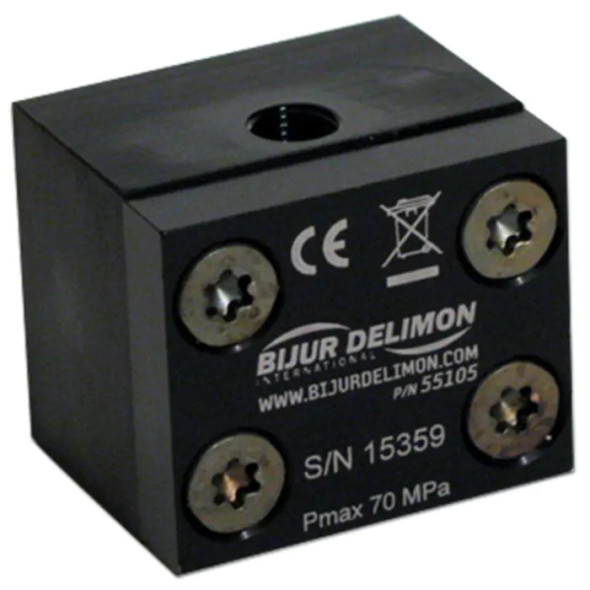

Bijur Delimon 55105 | Lube Point Monitor
Bijur Delimon
MSRP: $309.15$281.33The Bijur Delimon 55105 Lube Point Monitor provides precise confirmation that lubricant has successfully reached critical points in centralized lubrication systems. Using a dual-magnet oval-gear design, it converts every flow pulse into an electrical...BDI55105MSRP: $309.15$281.33
